
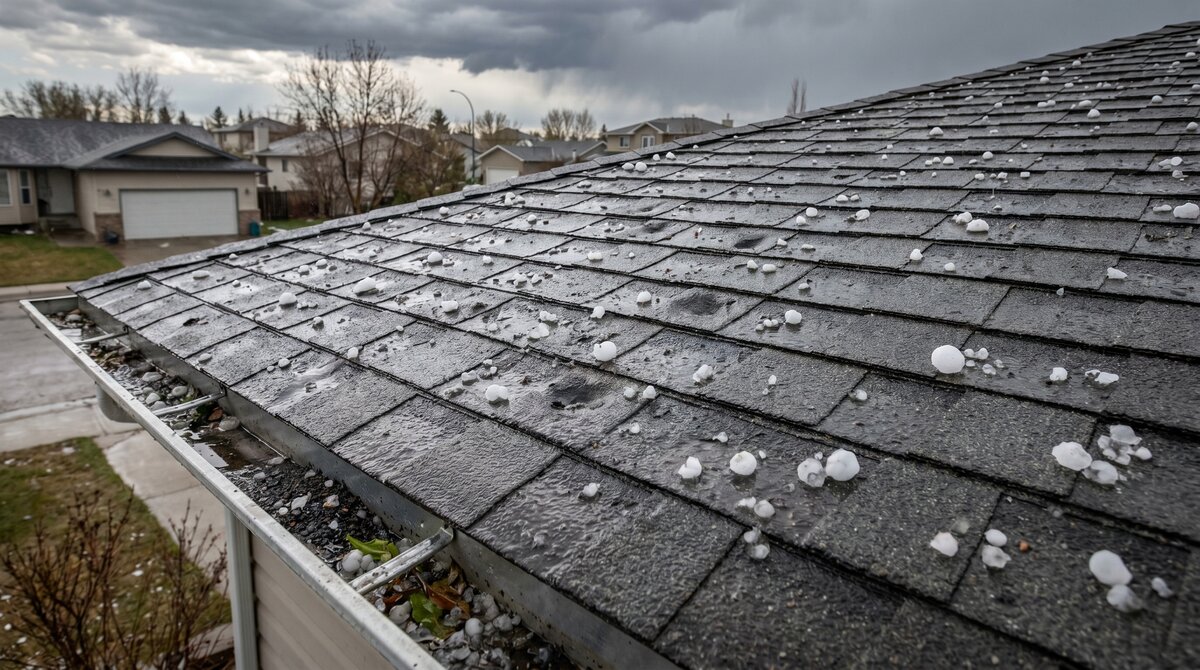
Hail-Driven Water Damage in Central Alberta: How Damaged Roofs Lead to Interior Flooding
Quick answer: Hail-driven water damage in central Alberta starts the moment hail breaches a roof and stops only when the rain stops. Water can travel from a punctured shingle through the attic, down wall cavities, and into finished basements within hours. Most homeowners don’t see the indoor flooding until 24–72 hours later. Fast emergency tarping, professional moisture mapping, and IICRC S500 drying are the only ways to prevent secondary mould and structural damage.
Key Takeaways
- A single hailstone larger than 25 mm can puncture asphalt shingles and start a hidden water pathway into a central Alberta attic.
- Hail-driven water damage typically becomes visible 24–72 hours after the storm, by which time secondary damage has often started.
- Water from a hail-breached roof can travel 4–9 metres horizontally inside wall cavities before showing on a ceiling or wall.
- Emergency tarping within 6–12 hours of the storm prevents most secondary water damage and protects the insurance claim.
- Hail water damage in central Alberta typically costs $4,500–$22,000 to restore once interior flooding starts.
Table of Contents
Why central Alberta is hail country
Central Alberta sits squarely inside one of the most active hail corridors in Canada. Red Deer, Lacombe, Sylvan Lake, Innisfail, Olds, and Stettler all average between four and seven significant hail events per summer. June through August is peak season, with the convective storms typically developing on hot afternoons when prairie heat collides with cooler foothills air. Hailstones in this region routinely reach the size of a Canadian quarter (24 mm) and can exceed the size of a golf ball (43 mm) during severe events.
Environment and Climate Change Canada’s historical weather records show that central Alberta records roughly twice the annual hail-day count of southern Saskatchewan and three times that of central British Columbia. Homeowners here are not unlucky when hail strikes; they are statistically likely to be hit. The damage path that follows is entirely predictable, and that predictability is what makes a fast response possible.
Most central Alberta roofs are standard asphalt three-tab or architectural laminate shingles. Both are vulnerable to hail above 25 mm. The shingles do not need to look obviously broken from the ground for water to be entering the attic; bruising, granule loss, and cracking around fastener heads are enough. By the time the storm ends, the interior cascade may already be underway.
How water travels from roof breach to basement
Hail-driven water damage rarely shows itself in the room directly under the breach. Water in a wood-framed Alberta home follows the path of least resistance, and that path is almost always horizontal before it becomes vertical. Understanding the cascade is the difference between catching it early and discovering it as a ceiling collapse two weeks later.
The cascade starts at the breached shingle. Once the shingle is punctured or its underlayment is cracked, rainwater following the storm enters the roof sheathing. From there it runs along the top of the sheathing toward the lowest point in the attic, which is rarely directly under the breach. It pools against the soffit or wall plate, then begins soaking the attic insulation. Wet insulation loses most of its thermal value within minutes and starts dripping moisture onto the ceiling drywall below.
Once the ceiling drywall gets wet, the water spreads laterally along the top of the drywall sheet, sometimes travelling four to nine metres before saturation becomes visible. It then begins penetrating down into wall cavities, riding the back side of drywall sheets and electrical wiring. In an open basement, water can finally appear as a wet drywall corner, a puddle near baseboards, or a damp section of subfloor underneath finished flooring. The same kind of pathway is why our water leaking from your ceiling guide stresses tracing the source upward rather than assuming the leak is local.
The five stages of hail water damage
The IICRC S500 standard for water damage restoration categorizes water by its source and contamination level, but for hail-driven interior flooding the more useful framework is timing. The earlier you intervene, the cheaper and faster the restoration. The table below shows the five stages a central Alberta home typically progresses through after a hail-breached roof.
| Stage | Time after storm | What is happening | Typical restoration cost |
|---|---|---|---|
| 1. Roof breach | 0–6 hours | Shingles punctured or cracked; water entering attic during continuing rain | Tarping + later repair: $400–$1,500 |
| 2. Attic saturation | 6–24 hours | Attic insulation absorbing water; ceiling drywall starting to wet | $1,800–$4,500 |
| 3. Ceiling & wall migration | 24–72 hours | Visible staining on ceilings; water tracking down inside wall cavities | $4,500–$10,000 |
| 4. Floor & basement | 3–7 days | Subfloor and basement materials wet; finishings damaged | $10,000–$18,000 |
| 5. Mould amplification | 7–30 days | Visible or hidden mould growth in wall cavities and attic | $15,000–$22,000+ |
The jump between stages 3 and 4 is where most central Alberta claims explode in cost. A homeowner who notices a ceiling stain on day two and calls a restoration company that day can usually keep the project under $7,000. A homeowner who waits ten days for the stain to dry out on its own and only calls when mould appears is almost always looking at five-figure damage. Our prior reporting on the true cost of water damage restoration in Canada tracks the same compounding pattern across other water sources.
Warning signs in the 72 hours after a hailstorm
The first 72 hours after a central Alberta hailstorm are the diagnostic window. Most homeowners walk the property and look at the roof from the ground; almost none check the inside. Inside is where the early evidence shows up first.
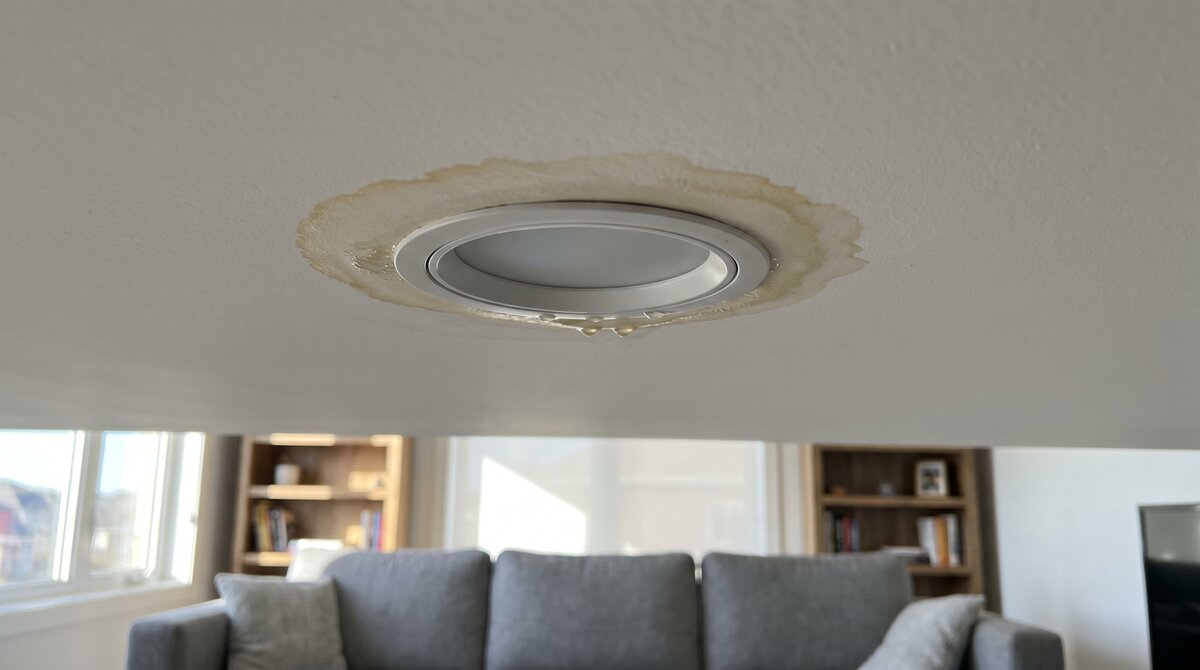
The earliest signs are subtle. The smell of damp wood or wet drywall in the upper hallway, especially near attic hatches and ceiling light fixtures, often appears before any stain. Ceiling fixtures can drip the moment they are turned on, because water has pooled in the electrical box above. Forced-air vents in upper rooms may briefly carry a musty draft when the furnace fan starts.
Within 24–48 hours, ceiling stains usually become visible. They typically appear as small yellow-brown rings, often near a wall rather than centred. The stains are almost never in the room directly under the roof breach — expect them to be one or two rooms over. Stains on second-storey ceilings should always be treated as urgent; water has already passed through one full floor system.
By 48–72 hours, basement signs start. A damp section of carpet near an exterior wall, a wet drywall corner in a finished basement, or condensation on a basement window during otherwise dry weather all suggest water has reached the lowest point of the cascade. At this point, every additional day of delay raises restoration cost by roughly fifteen to twenty per cent. The diagnostic logic is similar to what our summer storm roof damage guide outlines, but with hail the cascade tends to be faster and more concentrated.
What to do in the first 24 hours
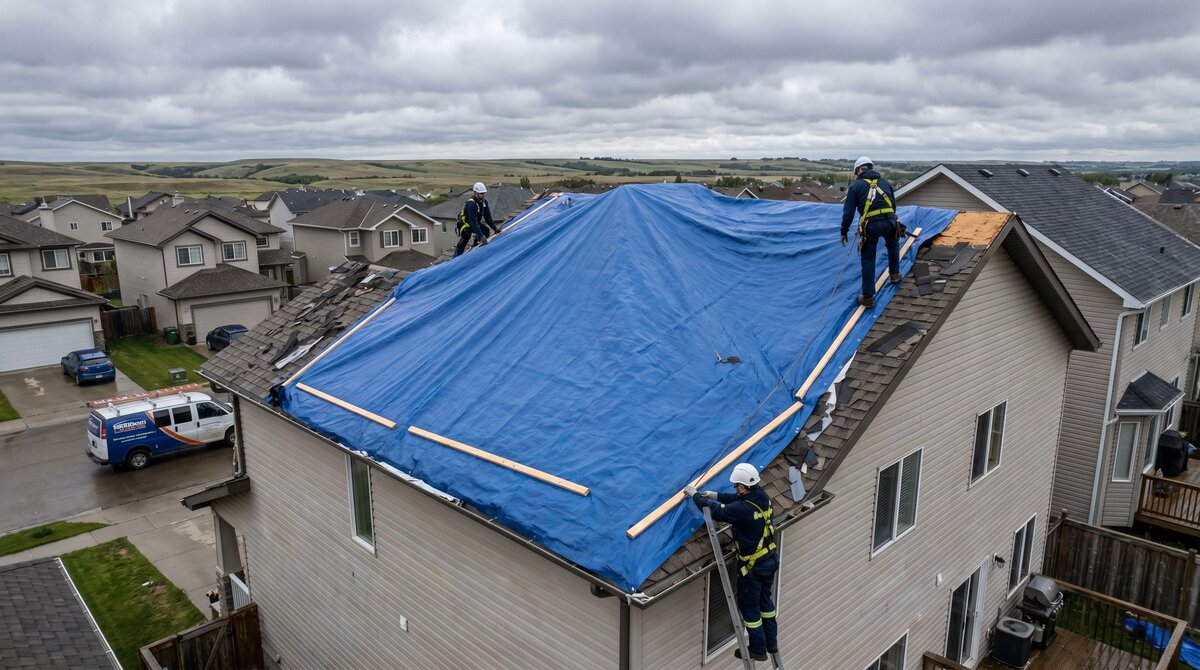
The single most important action in the first 24 hours after a central Alberta hailstorm is to stop more water from entering the home. That usually means professional emergency tarping. A properly installed tarp covers the breach area, extends past the soffit, and is mechanically fastened to the roof deck so it survives the next wind event. Plastic sheeting weighted with bricks is not tarping and will not survive a single overnight gust.
Immediately after tarping, document the damage. Photograph every elevation of the roof, every ceiling room by room, every wall in every room, and every floor surface. Date-stamped photos are gold for insurance adjusters. Save the original shingle fragments if any are on the ground; they are physical evidence of the strike. If a hailstone is on the deck or driveway, photograph it next to a coin or ruler before it melts.
Call your insurer the same day. Most Alberta homeowner policies cover hail-driven water damage as a single peril when the cascade originates from the storm. Insurers expect notification within 48 hours; longer delays start raising questions about secondary causes. Have a restoration company on site for moisture mapping within the same window if at all possible. Our how to file a property insurance claim after a disaster guide covers the adjuster meeting and scope-of-work conversations in detail.
If the water has already reached the inside of the home, the most important homeowner action is to stop the spread. Shut off electrical breakers to any rooms with active leaking. Move soft goods (rugs, upholstered furniture, mattresses) at least a metre away from wet areas. Open interior doors to encourage air movement. Do not pull down wet ceilings yourself; the weight of trapped water can collapse a sheet onto whoever pulls the first corner. Leave that to water and flood damage restoration technicians who have done it many times.
Why DKI Central Alberta is the right call for hail water damage
DKI Central Alberta is a locally owned member of Canada’s largest disaster restoration network, and we keep hail season crews on standby through June, July, and August every year. When the storm cells start showing on the radar, our trucks are already loaded with tarping materials, moisture meters, drying equipment, and air movers. Response times across the Red Deer corridor and surrounding acreage communities are routinely under two hours during peak season.
Our IICRC-certified water damage technicians use thermal imaging cameras to find wet areas hidden inside walls before the homeowner can see any stain. Moisture mapping is documented and shared with the insurance adjuster directly, which speeds approval and removes the most common point of dispute over scope. We carry direct billing agreements with every major Alberta insurer, so out-of-pocket expense during the claim is minimized. Service area includes Red Deer, Sylvan Lake, Lacombe, Innisfail, Olds, Bowden, Penhold, Blackfalds, Stettler, Ponoka, Rocky Mountain House, Sundre, Three Hills, Caroline, Eckville, Rimbey, Delburne, and surrounding acreage country.
What sets us apart from out-of-town crews flown in for hail season is the second-pass verification. Every hail water restoration project ends with a final moisture map and an air-sample reading. The home is not handed back until subfloor, framing, and drywall measurements are at or below pre-loss levels. That verification catches the small pockets that lead to mould rebound — the exact pattern our mould on concrete coverage warns about — and it is the reason our hail-season callback rate stays close to zero.
Conclusion
Hail-driven water damage in central Alberta starts with a roof breach but rarely ends at the roof. The cascade through attic, ceilings, walls, and basements is fast, predictable, and entirely preventable if a homeowner acts inside the 72-hour diagnostic window. Emergency tarping, immediate documentation, prompt insurance notification, and professional moisture mapping convert a five-figure restoration into a manageable four-figure project. If a central Alberta hailstorm passed over your home in the last few days, treat the next 72 hours as the most important window of the season, and call a restoration company before the cascade reaches your basement.
Frequently Asked Questions
How long after a hailstorm does interior water damage usually appear?
Interior signs of hail-driven water damage typically appear 24–72 hours after a central Alberta hailstorm. The first indicators are usually smell or condensation rather than visible stains, because water tracks horizontally inside attics and wall cavities for several metres before it shows on a ceiling.
Does Alberta home insurance cover hail-driven water damage?
Yes. Most standard Alberta homeowner policies cover hail damage and the interior water damage that cascades from it as a single peril, provided the policyholder notifies the insurer within 48 hours and documents the damage with photos. Delays beyond that window are when claims start getting questioned.
What size of hail is large enough to damage an asphalt shingle roof?
Hailstones larger than about 25 mm (the size of a Canadian quarter) can puncture standard asphalt three-tab shingles and crack architectural laminates. Stones above 38 mm almost always cause functional damage even when the shingles look intact from the ground.
Should I climb on the roof to check for hail damage after a storm?
No. Homeowners should not climb hail-impacted roofs. Granule loss makes the surface slippery, hidden cracks make sheathing unsound, and ladder falls cause more injuries than the storm itself. Use binoculars from the ground or hire a professional inspection.
How quickly do I need emergency tarping after a hailstorm in central Alberta?
Emergency tarping should be in place within 6–12 hours of the storm ending, or before the next rain event, whichever comes first. Tarping that quickly is what prevents most secondary water damage and keeps the eventual restoration project under $7,000 in most cases.
Will my insurer pay for emergency tarping?
Almost always, yes. Emergency mitigation expenses, including same-day tarping and moisture mapping, are considered part of the loss-reduction obligation under standard Alberta policies. Keep itemized receipts and submit them with the claim package; reputable restoration companies bill these directly to the insurer where possible.