
Services
Hail Damage Restoration
Hail can crack shingles, break windows and skylights, and let water into your attic and ceilings, sometimes days after the storm has passed. DKI Central Alberta tarps, boards up, dries and cleans up hail-damaged homes and businesses 24/7 across Red Deer and Central Alberta.
Hail damage restoration in Red Deer and Central Alberta
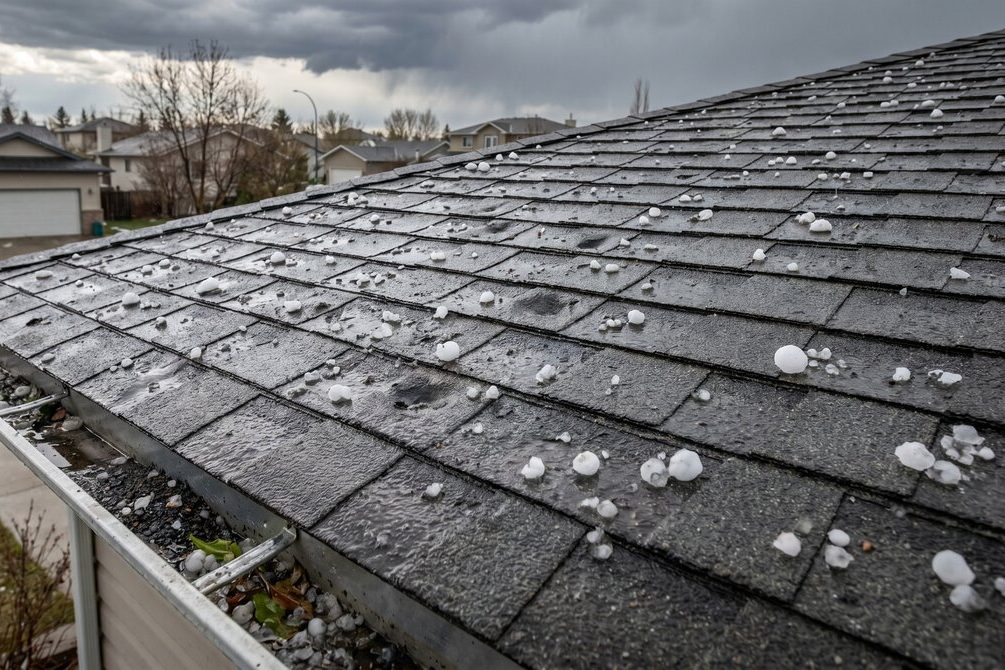
Hail damage isn’t always obvious from the ground. Hailstones can crack shingles, dent flashing and vents, split siding and break windows and skylights, and the leak that follows may not show up until the next rain. Once water reaches the attic, insulation, drywall and framing can stay wet out of sight.
DKI Central Alberta responds 24/7 to hail-damaged homes and businesses in Red Deer and the surrounding towns. We secure the building, find where the water went and dry it to measured moisture levels, so a roof leak doesn’t turn into a mould problem. Our IICRC-trained technicians document everything for your insurance claim. If the same storm brought high winds, see our wind damage restoration service, and our storm damage restoration page for everything else.
Our hail damage services:
24/7 emergency roof tarping
Board-up of broken windows and skylights
Water extraction from ceilings, walls and floors
Removal of wet insulation and drywall
Structural drying with moisture monitoring
Mould prevention and odour control
Photos and moisture records for your insurer
What hail damage looks like
Most hail damage starts on the outside of the building, but the costly part is often the water that gets in afterwards.
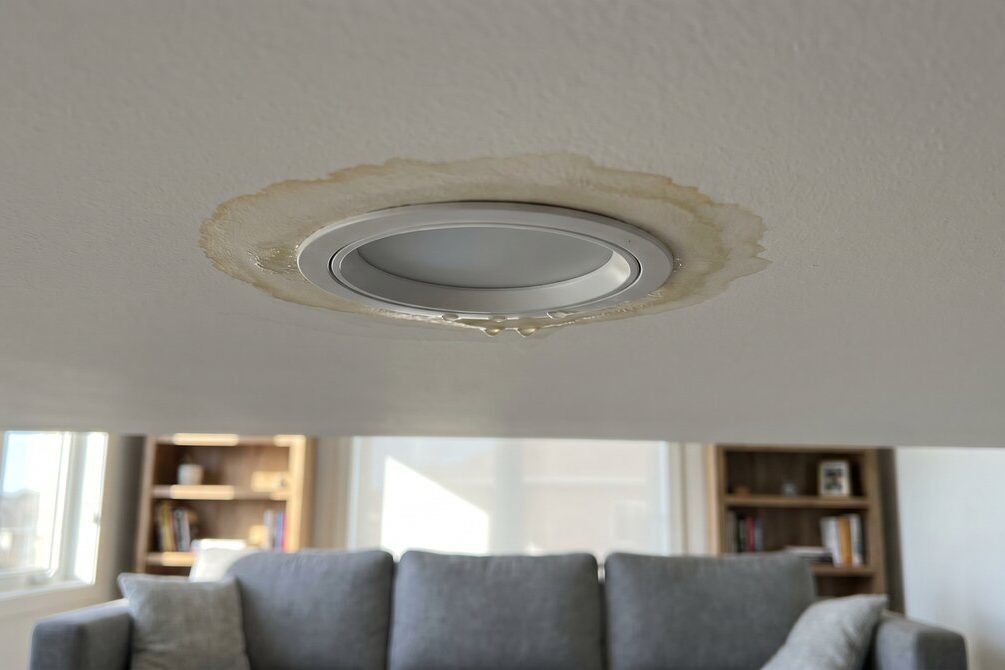
Leaks that show up later
A stain around a light fixture or a drip from the ceiling days after a storm usually means water is getting past damaged shingles or flashing. Our guide to hail-driven water damage explains what to look for.
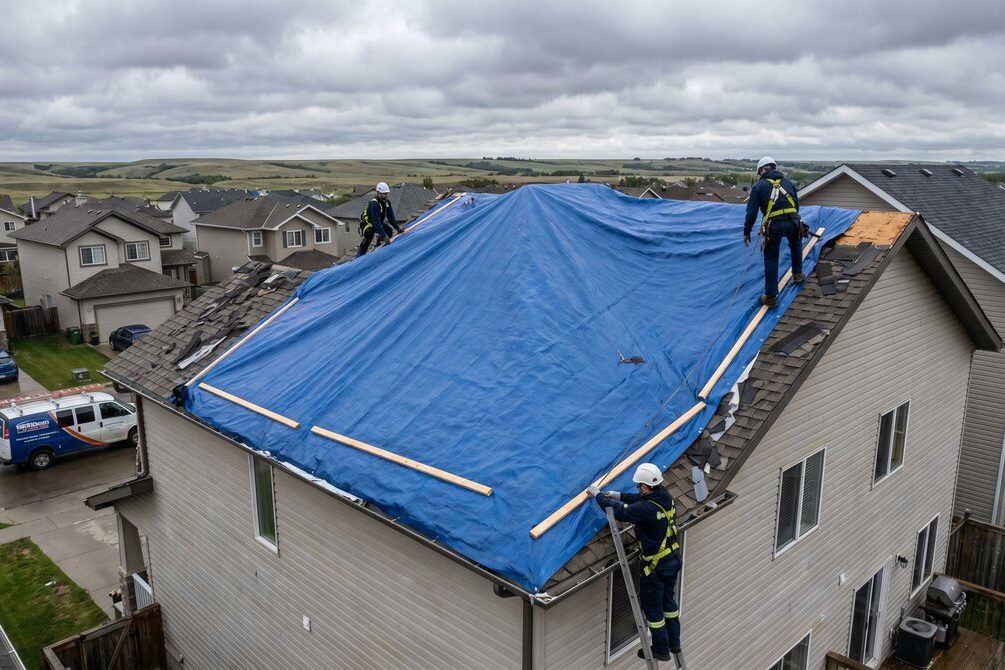
Emergency roof tarping
If the roof is open, a properly secured tarp keeps rain and melting hail out until permanent repairs can be made. See our emergency board-up and tarping service.

Drying and cleanup
We extract water, remove wet insulation and drywall, and dry the structure with air movers and dehumidifiers, checking moisture until it’s dry. Learn more about our water damage restoration.
Why Central Alberta gets so much hail
Red Deer sits in Hailstorm Alley, the stretch from High River north through Calgary and Red Deer to Lacombe, and west to Rocky Mountain House. The Insurance Bureau of Canada (IBC) says Alberta has had at least one major hailstorm every year for the past two decades. The Government of Canada says the Calgary to Red Deer area “can expect up to 10 hailstorms a year,” and the Government of Alberta puts the peak of hail season from mid-June to early August.
Canada’s record hailstone fell northwest of Markerville on August 1, 2022. Western University researchers measured it at 123 mm across and 292.71 g. On August 23, 2026, hail of about 3.75 to 4 cm hit Springbrook and Gasoline Alley in Red Deer County. News reports said it shredded siding and smashed windows in Springbrook, and IBC puts insured losses at nearly $40 million.
Insurers even fund a cloud-seeding program, the Alberta Hail Suppression Project, which runs from June 1 to September 15. IBC notes that it doesn’t prevent all hail from falling; it reduces the size of hailstones.
Costly hailstorms near Red Deer:
August 8, 2008: Red Deer, $51.9 million insured
August 7, 2014: Central Alberta, $546.5 million
July 21, 2015: Red Deer, Lacombe, Ponoka and Rocky Mountain House, $259.3 million
June 20, 2017: Red Deer, Innisfail and Sylvan Lake, $36.1 million
August 23, 2026: Springbrook, nearly $40 million
What to do after a hailstorm
Stay clear of downed power lines and broken glass, and don’t climb onto a wet or damaged roof. Then photograph the roof, siding, windows, vehicles and any interior leaks before anything is covered or repaired. If it’s safe, collect a few hailstones and photograph them next to a ruler or coin before they melt.
Next, stop more water getting in. Alberta’s Insurance Act says you “must take all reasonable steps to prevent further loss or damage”, and your insurer must contribute toward reasonable costs for doing so, so keep every receipt. Watch ceilings, attics and window frames over the next few days, because slow leaks often appear after the next rain.
Your first steps:
Make sure everyone is safe
Photograph the damage before temporary repairs
Tarp the roof and board up broken windows
Check the attic and ceilings for leaks
Keep receipts and damaged items
Call your insurer to start a claim
Hail damage and your insurance claim
In Alberta, Statutory Condition 6 requires you to “immediately give notice in writing” to your insurer and to deliver a proof of loss “as soon as practicable.” The statutory conditions set no 90-day deadline, but reporting quickly protects your claim. Once a completed proof of loss is delivered, the loss is payable within 60 days unless your policy sets a shorter period.
Check your policy for a hail deductible, which IBC says is “typically higher than the usual home insurance deductible,” and for a roof and siding endorsement that limits those settlements to actual cash value. IBC also says “you are not obligated to use the contractor that your insurer recommended.” Our guide on how to file a hail damage insurance claim in Alberta walks through each step, and our insurance claim help page explains how we document the damage.
We support your claim with:
Photos of the damage and our emergency work
Moisture readings and drying records
A list of materials we remove and why
A contents inventory if belongings are damaged
Documentation your adjuster can review
Hail damage questions
Can hail damage cause a leak days after the storm?
Yes. Cracked shingles and damaged flashing may not leak until the next heavy rain or snowmelt. Watch your ceilings and attic for stains in the days after a hailstorm, and call us at the first sign of water.
Who pays for tarping or boarding up after hail?
Alberta’s Statutory Condition 9 requires you to take reasonable steps to prevent further damage, and your insurer must contribute on a prorated basis toward reasonable and proper costs for those steps. Keep every receipt and take photos before and after.
Is there a deadline to report hail damage in Alberta?
The statutory conditions require you to give your insurer written notice immediately and to deliver a proof of loss as soon as practicable. There’s no 90-day rule in them, but report the damage as soon as you can.
Does home insurance cover hail damage?
The Insurance Bureau of Canada says standard home and business policies cover damage caused by hail, including water that enters through openings the hail suddenly created. Pre-existing damage isn’t covered, and many policies have a separate hail deductible.
What is a hail deductible?
Some Alberta home policies have a separate deductible for hail, which the Insurance Bureau of Canada says is typically higher than the usual deductible. Your policy may also pay only actual cash value for an older roof or siding, so check with your broker.
Can I choose my own restoration company after a hailstorm?
Yes. The Insurance Bureau of Canada says you are not obligated to use the contractor your insurer recommends. Get an estimate from the company you choose and ask your adjuster how much of it the insurer will pay before work starts.
Do you handle hail damage on commercial buildings?
Yes. We tarp, board up, extract water and dry offices, stores, warehouses and other commercial properties after hail. See our commercial restoration service.
DKI Central Alberta Offers...
At DKI Central Alberta, we know that dealing with property damage is overwhelming—that’s why our franchisees are ready to respond 24/7, every day of the year. With over 30 years of industry experience and IICRC-certified experts, we bring the knowledge, speed, and care needed to restore your home or business efficiently. From the moment you call, a dedicated Project Manager will guide you through the process, keeping you informed every step of the way. Our team is committed to delivering high-quality results while providing the compassion and support you need to get back on your feet as quickly as possible.
Quick Mobilization
24/7 emergency restoration and board-up services available 365 days a year.
Expertise
Fully trained and certified IICRC staff and more than 30 years of industry experience.
Strong Communication
A project Manager assigned to your claim from start to finish, updating you throughout the process.
Quality Assurance
Making sure you are happy with the final result of the work done and standing behind the work we do.
Compassionate Team
We understand how hard the situation is and our team will do what we can to get you back to normal sooner.
Have An Emergency?
Call Us Right Away
24/7 Emergency Line
(403) 224-0350