
How Fast Does Mould Grow After Water Damage? A Central Alberta Guide
Mould can begin growing within 24 to 48 hours of a leak, flood or sewer backup, and by day three it is often already colonizing drywall, carpet underlay and framing you cannot see. That timeline is the single most important fact about mould after water damage, because it means the decisions you make in the first two days decide whether you are drying a basement or gutting one. This guide explains the hour-by-hour timeline, what speeds mould up in Central Alberta homes, how to check for it, what you can safely do yourself, and when professional remediation is the only sound option.
Table of Contents
- How fast mould grows after water damage
- Day-by-day mould timeline after a water event
- What makes mould grow faster in Central Alberta homes
- How to check for mould after water damage
- How to stop mould in the first 48 hours
- When professional mould remediation is necessary
- Is mould from water damage dangerous?
- Why DKI Central Alberta is the right choice for water damage and mould remediation
- Conclusion
- Frequently Asked Questions
Key Takeaways
- Mould after water damage can start growing within 24 to 48 hours and is usually visible or smellable within 3 to 12 days.
- Materials that stay wet for more than 48 hours — drywall, carpet underlay, insulation, particleboard — should be treated as mould risks even if nothing is visible yet.
- Health Canada advises homeowners can clean small mould patches under 1 square metre themselves, while areas over 3 square metres call for professional remediation.
- Sewer backups and floodwater (Category 3 water) grow mould fastest and require removal of porous materials rather than drying.
- Fast professional drying to IICRC S500 standards within the first 48 hours is the most reliable way to prevent a mould remediation job.
How fast mould grows after water damage
Mould spores are already present in every home, and they germinate within 24 to 48 hours once they land on a wet surface with something to eat. Drywall paper, wood, carpet backing, dust and cardboard are all food. Warmth speeds the process: in a Central Alberta basement in summer, or any room with the furnace running in winter, the growth window sits at the short end of that range.
Germination is not the same as visible mould. In the first two days the growth is microscopic. By day three to five, colonies start to form on the wettest materials; by one to two weeks you will typically see fuzzy or stained patches and notice a musty odour. The reason restoration companies push so hard on the 48-hour mark is that after it, drying alone is no longer enough — anything still wet has to be treated as contaminated. Health Canada’s guide to addressing moisture and mould indoors makes the same point: the cause of the moisture has to be fixed and materials dried quickly, or the mould will return.
Day-by-day mould timeline after a water event
The table below is what our technicians use to explain urgency to Central Alberta homeowners after a burst pipe, appliance leak, sewer backup or basement flood. Times assume normal indoor temperatures and no active drying.
| Time since water event | What is happening | What you should do |
|---|---|---|
| 0 to 24 hours | Water wicks into drywall, underlay and framing; spores land and begin to activate | Stop the source, extract water, start fans and dehumidifiers, call for assessment |
| 24 to 48 hours | Spores germinate; growth begins inside wet porous materials | Professional drying should be running; lift carpet, remove wet underlay |
| 3 to 5 days | Colonies form on the wettest surfaces; musty odour may start | Anything still wet is now a removal candidate, not a drying candidate |
| 1 to 2 weeks | Visible fuzzy or stained growth; spreads behind baseboards and inside walls | Contain the area; professional remediation for anything beyond a small patch |
| 3 weeks and beyond | Established colonies release spores into the air; structural staining and rot begin | Full remediation with air scrubbing, material removal and post-clearance testing |
What makes mould grow faster in Central Alberta homes
Four factors decide whether mould appears in two days or two weeks, and most Central Alberta water losses hit at least three of them.
The type of water. Clean supply-line water (Category 1) gives you the most time. Grey water from a dishwasher, washing machine or sump overflow (Category 2) carries nutrients that feed mould. Sewer backups and overland flooding (Category 3) carry bacteria and organic matter and grow mould fastest; our guide to sewer backup cleanup in Central Alberta explains why porous materials are removed rather than dried in those cases.
The materials that got wet. Paper-faced drywall, particleboard cabinets, carpet underlay, fibreglass batts and cardboard boxes hold water and feed mould. Concrete, tile and metal do not feed it, though mould will grow on the dust and grime sitting on them — see our post on whether mould can grow on concrete.
Temperature and humidity. Mould grows fastest between roughly 20 and 30°C with relative humidity above 60 percent. A finished basement with the furnace running and no dehumidifier is close to ideal. Health Canada recommends keeping indoor humidity between 30 and 50 percent, which is also the target restoration crews dry to.
Hidden moisture. The slowest problems to surface are the ones behind finished walls: a slow leak from a ceiling, a cracked foundation wall behind a basement bedroom, or a supply line inside a wall. If you have noticed water stains, read our guide on what to do if water is leaking from your ceiling before the mould timeline starts running.
How to check for mould after water damage
Mould after water damage is often invisible for the first week, so you check for moisture first and mould second.
- Smell. A musty, earthy or damp-basement odour that gets stronger when the furnace or air conditioning runs is the earliest sign, and it usually shows up before anything is visible.
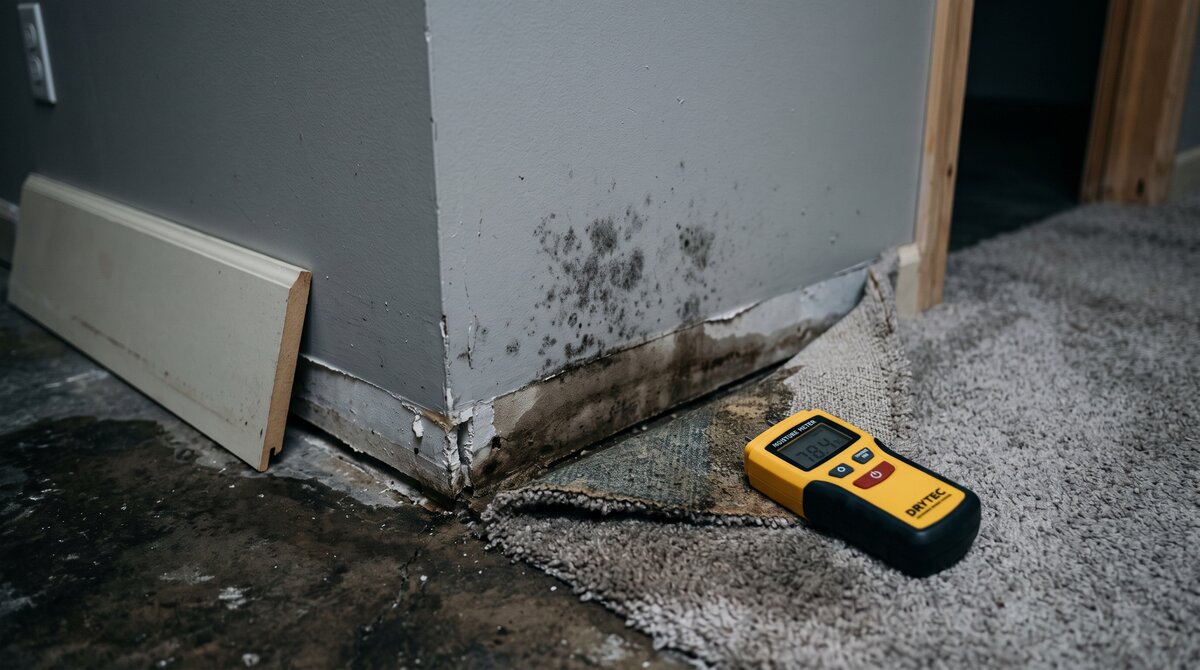
- Look at the edges. Check the bottom 30 cm of drywall, behind baseboards, under carpet and underlay, inside the bottom of cabinets and along window frames. Early growth looks like small dark specks, fuzzy grey or white patches, or a faint stain.
- Feel for moisture. Drywall that feels cool or soft, bubbling paint, and swollen baseboards mean the material is still wet inside even if the surface is dry.
- Use a moisture meter. A pin-type meter reads the moisture content of drywall and wood directly. Anything above roughly 16 percent in wood or “wet” on a drywall scale after 48 hours is a mould risk.
- Do not rely on colour. Mould can be black, green, white, grey or pink. Our mould identification guide covers the common types found in Central Alberta homes.
How to stop mould in the first 48 hours
You cannot stop spores from landing, but you can take away the water before they germinate. If the water is clean and the area is small, these steps buy you the time you need.
- Stop the source. Shut the main valve, the appliance supply line or the sump breaker. If you are not sure where the shut-off is, our post on finding and turning off the main water shut-off valve walks through it.
- Extract standing water fast. A wet vacuum or a rented extractor, not towels. Every hour of standing water pushes more moisture into the walls.
- Lift and remove. Pull carpet back, discard wet underlay, move furniture off wet floors and empty the bottom of closets and cabinets.
- Move air and remove humidity. Run fans across wet surfaces and a dehumidifier in the room, with doors closed to the rest of the house. Open windows only if the outdoor air is drier than the indoor air.
- Cut inspection openings. If water reached the base of finished walls, remove baseboards and drill or cut small openings so air reaches the wall cavity. Wet insulation should come out.
- Check readings daily. If a moisture meter still reads wet on day three, drying at home has failed and the material needs professional handling.
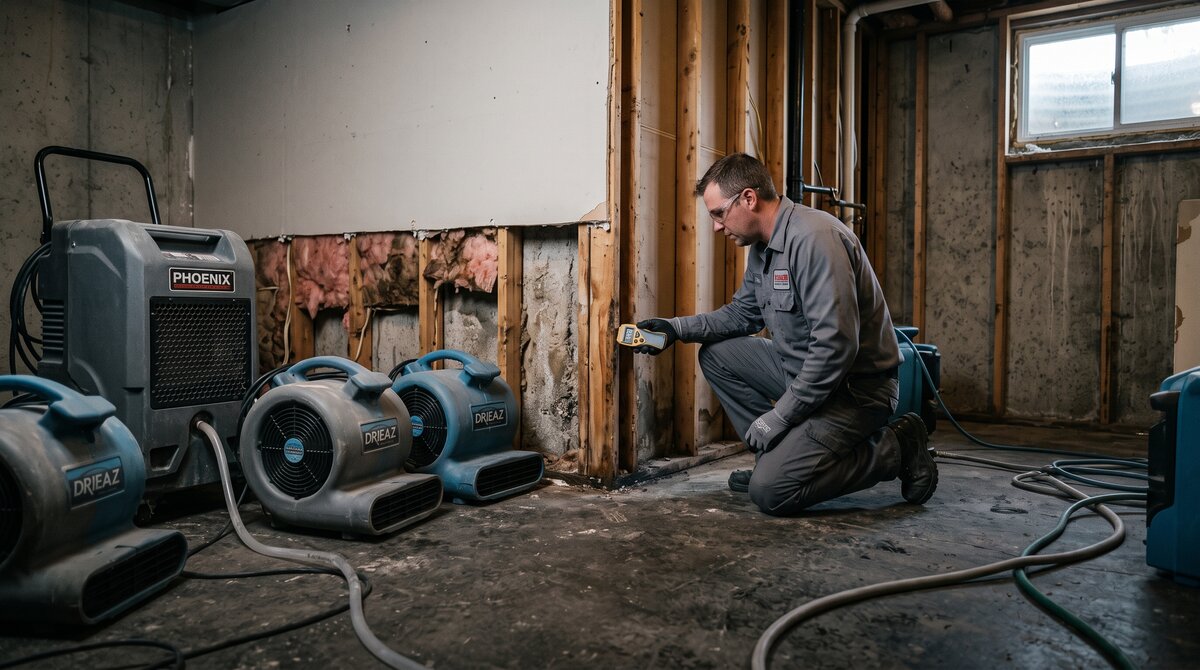
Household fans and a consumer dehumidifier can dry a small clean-water spill. They cannot dry a saturated finished basement; that takes commercial air movers, low-grain refrigerant dehumidifiers and daily moisture mapping to the IICRC S500 water damage restoration standard, which is what a professional crew brings on day one.
When professional mould remediation is necessary
Health Canada’s guidance sorts mould problems by size: small patches under 1 square metre can be cleaned by a homeowner with detergent and water, medium areas of 1 to 3 square metres need more care and protective equipment, and anything over 3 square metres, or any mould inside wall cavities or HVAC systems, should be handled by professionals. In practice, any of the following after water damage means it is time to call.
- Materials were wet for more than 48 hours before drying began.
- The water was grey or black (sewer backup, floodwater, sump overflow).
- Mould is visible on more than a patch the size of a bath towel, or in more than one room.
- There is a musty odour but no visible source, which points to growth inside walls or under floors.
- Anyone in the home has asthma, allergies, a weakened immune system, or is very young or elderly.
- Insurance is involved and the adjuster needs documented moisture readings and a remediation protocol.
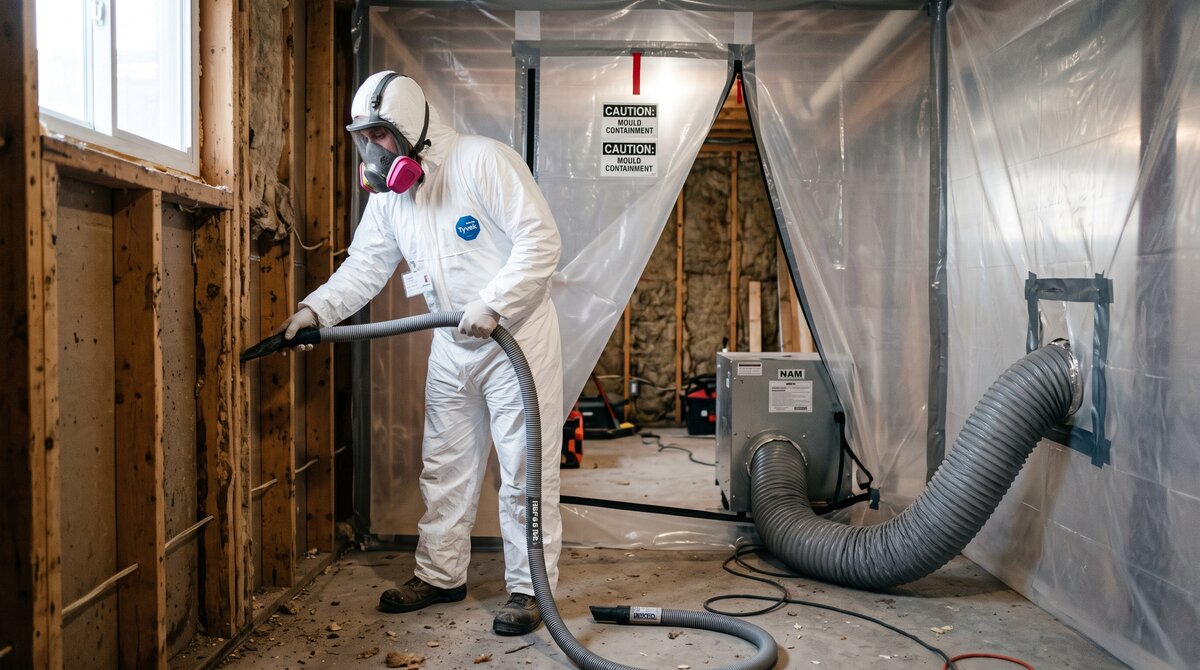
Professional remediation follows the IICRC S520 mould remediation standard: containment with negative air pressure, HEPA air scrubbing, removal and bagging of contaminated porous materials, HEPA vacuuming and antimicrobial cleaning of what stays, drying to target, and clearance verification. Our guide to mould remediation costs in Central Alberta breaks down what that work runs in 2026, and our mould remediation service page explains the process in detail.
Is mould from water damage dangerous?
Health Canada has concluded that indoor mould growth can be a health hazard. The most common effects are eye, nose and throat irritation, coughing, wheezing, and worsening of asthma and allergy symptoms. Children, seniors and people with respiratory conditions or weakened immune systems are most affected. There is no safe type of mould to leave in a home; the colour of the growth does not tell you how harmful it is.
The practical rule is that any mould growing on a water-damaged material in a living space should be removed, the material dried or replaced, and the moisture source fixed. Cleaning the surface without fixing the water problem is the most common reason mould comes back within weeks.
Why DKI Central Alberta is the right choice for water damage and mould remediation
DKI Central Alberta handles water damage and mould remediation as one continuous job, which is exactly how the mould timeline demands it. Our crews respond 24/7 across Red Deer, Sylvan Lake, Lacombe, Blackfalds, Innisfail, Olds, Ponoka, Rocky Mountain House and the acreages in between, with truck-mounted extraction, commercial drying equipment and thermal imaging on the first visit. Technicians are trained to the IICRC S500 water damage and S520 mould remediation standards.
Because we document moisture readings from day one, we can show your insurer exactly when drying began and what was saved, which matters for coverage. As part of the DKI network, Canada’s largest disaster restoration organization, we bring the containment, air filtration and clearance testing that a proper remediation needs, and one team takes the job from wet basement to rebuilt, mould-free space.
Conclusion
Mould after water damage is a race against a 48-hour clock. Spores germinate within one to two days on wet drywall, carpet and framing, colonies form within a week, and by three weeks an established problem is releasing spores into the air your family breathes. Stop the water, extract it, get air moving and call for professional drying early, and most Central Alberta water losses never become mould losses. Wait, and the drying job becomes a remediation job with walls opened and materials removed. If you are inside that first window right now, act on it today.
Frequently Asked Questions
How likely is mould after water damage?
Very likely if porous materials stay wet for more than 48 hours. Drywall, carpet underlay, insulation and particleboard that are not dried within two days should be assumed to be growing mould even when nothing is visible, especially in a warm Central Alberta basement.
Does water damage always cause mould?
No. A clean-water leak that is extracted and fully dried within 24 to 48 hours usually does not lead to mould. The problems come from delayed drying, hidden moisture inside walls and floors, and contaminated water from sewer backups or flooding.
What does mould from water damage look and smell like?
Early growth looks like small dark specks, fuzzy grey, white or green patches, or a faint stain along the bottom of walls, behind baseboards or under carpet. The smell is musty, earthy or like a damp basement, and it often appears days before anything is visible.
Can I dry out water damage myself to prevent mould?
For a small clean-water spill, yes: extract the water, remove wet underlay, run fans and a dehumidifier, and check with a moisture meter. A saturated finished basement or any grey or black water needs commercial drying equipment within the first 48 hours.
Is mould from water damage dangerous?
Health Canada considers indoor mould a potential health hazard. It can irritate the eyes, nose and throat and worsen asthma and allergies, with children, seniors and people with respiratory or immune conditions most at risk. Any mould on water-damaged material should be removed.
Does home insurance cover mould after water damage in Alberta?
Most Alberta policies cover mould that results from a sudden, covered water loss such as a burst pipe, often up to a stated sub-limit. Mould from long-term leaks, neglected maintenance or seepage is usually excluded, so report water damage and start drying immediately.