Quick answer: It might. Alberta’s Asbestos Abatement Manual lists acoustic and stippled (“popcorn”) ceiling finishes among materials that can contain asbestos, and you can’t confirm it by looking. Before you scrape, sand or drill a textured ceiling in an older home, have a sample tested by a lab.
That matters in Red Deer, where about 48% of occupied homes were built in 1990 or earlier, according to the 2021 Census. Health Canada says asbestos was mainly used to insulate buildings and homes before 1990.
Key Takeaways
- Alberta’s Asbestos Abatement Manual lists acoustic and stippled (“popcorn”) finishes as possible asbestos-containing materials.
- Neither the look of the ceiling nor the age of the house can confirm asbestos. A lab has to analyze a sample.
- Scraping and sanding release fibres. Left intact, asbestos poses no significant health risk, according to Health Canada.
- A contractor must notify Alberta OHS at least 72 hours before asbestos work, use certified workers, and seal and label the waste.
- Your options are to leave it alone, encapsulate it, enclose it or remove it.
Table of Contents
- Can a popcorn ceiling contain asbestos?
- Can you tell from the age of your home?
- How does asbestos testing work?
- Why is scraping or sanding risky?
- What must a contractor do in Alberta?
- What are your options for a popcorn ceiling?
- Do you need an asbestos report for a Red Deer permit?
- Frequently asked questions
- Sources
Can a popcorn ceiling contain asbestos?
Yes. The Alberta Asbestos Abatement Manual (2019) lists “acoustic and stippled finishes” on ceilings and walls among products that may contain asbestos. Alberta Health Services also names textured wall and ceiling finishes among building materials used before 1990 that may contain it.
Health Canada’s asbestos page doesn’t mention popcorn ceilings by name, but it advises hiring a professional to test for asbestos before renovating or remodelling. The Canadian Centre for Occupational Health and Safety (CCOHS) lists sanding or disturbing textured acoustical plaster on ceilings and walls among home activities that can release asbestos fibres.
Breathing in asbestos fibres can cause lung cancer, mesothelioma, asbestosis and other diseases, and Alberta OHS notes most people show no symptoms for at least 10 years. Textured ceilings are one of several suspects in older homes. Others include drywall mud, vinyl floor tiles, pipe insulation and vermiculite attic insulation.
Can you tell from the age of your home?
Not reliably. Age gives you a rough risk level, not an answer:
- Alberta OHS says homes built before 1990 carry a higher risk.
- Alberta Health Services recommends testing before renovating any building built before the early 1990s.
- The Alberta Manual notes asbestos has been found in buildings constructed after 1980 into the early 1990s.
Canada’s federal asbestos ban took effect on December 30, 2018, but it doesn’t apply to asbestos already built into homes before that date. If your ceiling went up before the early 1990s, treat it as suspect until a lab says otherwise.
How does asbestos testing work?
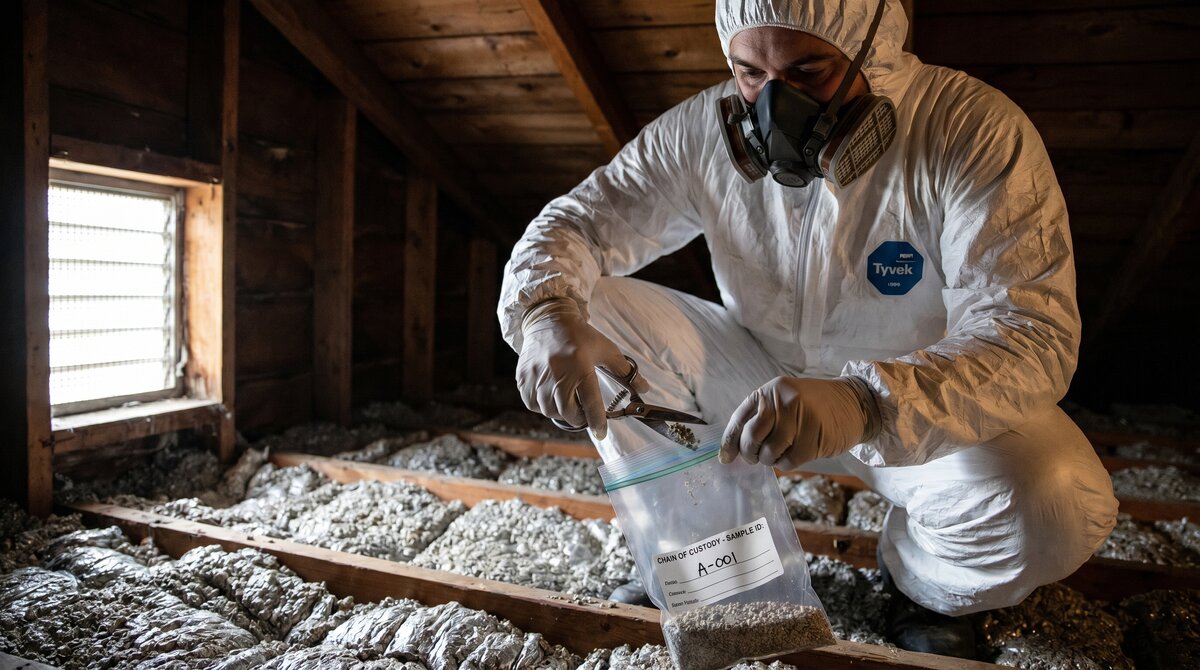
According to the Alberta Manual, a visual inspection can’t confirm asbestos. A competent person has to collect samples, and a lab has to analyze them. Done properly, bulk sampling is a low-risk task. The process usually looks like this:
- The material is misted with water and a small sample of the texture is taken.
- The sampled spot is repaired right away so loose material isn’t left exposed.
- Because the Manual warns that stipple may not have been mixed evenly, asbestos content can vary across one ceiling. A large ceiling may need more than one sample.
- The lab analyzes the sample by polarized light microscopy (PLM), the primary method for bulk samples. Results under 1% are reported as “<1%”.
- Results typically take 3 to 5 business days. Some labs offer next-day or 24-hour rush service at a higher rate.
The Manual recommends using a lab that takes part in proficiency testing, such as the AIHA Asbestos Analysts Registry, or is accredited through CALA. For typical testing and removal prices, see our guide to asbestos removal costs, process and testing in Alberta.
Why is scraping or sanding risky?
Health Canada says asbestos that is left undisturbed or sealed behind walls poses no significant health risk. The risk starts when the material breaks apart and fibres get into the air. Scraping, sanding and drilling a textured ceiling do exactly that, right above your head.
Alberta sets a workplace exposure limit for all forms of asbestos of just 0.1 fibres per cubic centimetre over an 8-hour shift, and classes asbestos as a confirmed human carcinogen. Alberta Health Services advises against using power tools or sanders on materials that may contain asbestos.
Alberta’s OHS asbestos rules apply to employers and contractors. Work an owner-occupier does on their own home generally falls outside the OHS Act. Even so, Health Canada and Alberta Health Services strongly advise against disturbing suspected asbestos yourself and recommend hiring a qualified professional.
What must a contractor do in Alberta?
Alberta’s asbestos rules sit in Part 4 of the Occupational Health and Safety Code (sections 28 to 40). They apply to employers, which includes any contractor you hire. Key requirements:
- Notify Alberta OHS at least 72 hours before starting work that may release asbestos fibres, through the online Asbestos Project Notification portal (s. 36). The notice is not an approval.
- Use workers who hold an Alberta asbestos worker certificate (s. 37). The approved course runs at least 14 hours, and cards expire after 3 years.
- During a renovation, encapsulate, enclose or remove any material in the work area that could release fibres (s. 35).
- Seal asbestos waste in labelled containers marked as carcinogenic (s. 38) and take it only to a landfill approved to accept it.
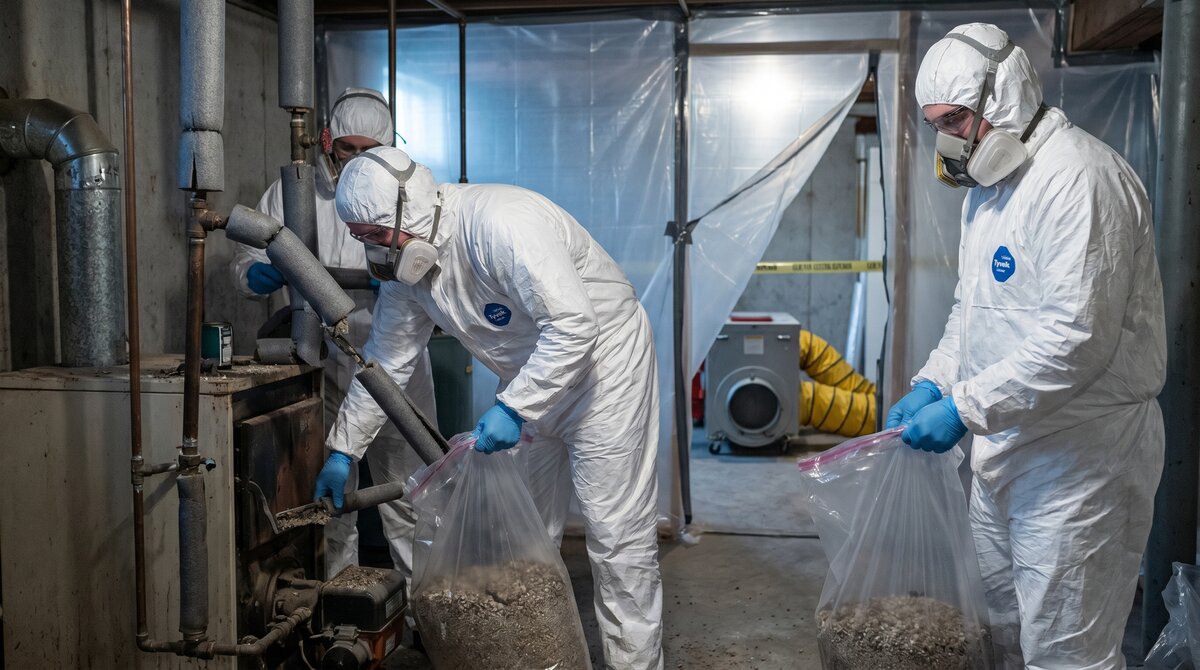
Alberta’s Manual sorts the work itself into low-, moderate- and high-risk procedures, all built on isolating the work area, protecting workers, limiting fibre release and decontaminating properly. In Alberta it’s the workers who are certified, so ask to see the crew’s asbestos worker certificates.
What are your options for a popcorn ceiling?
Alberta’s OHS Code defines “abate” as to encapsulate, enclose or remove asbestos-containing material. Leaving it alone is the fourth choice.
| Option | What it means | When it makes sense |
|---|---|---|
| Leave it undisturbed | Keep the ceiling intact. No drilling, sanding or scraping. | The ceiling is in good shape and you aren’t renovating that area. |
| Encapsulate | Seal the material in place so fibres stay bound. | The texture is intact but you want added protection against minor wear. |
| Enclose | Cover the ceiling with a barrier, such as a new ceiling layer, so it can’t be disturbed. | You want a new look without removing the old finish. |
| Remove | Certified workers take it out under containment and send it to an approved landfill. | You’re renovating, demolishing, or the ceiling is damaged. |
If you encapsulate or enclose, the asbestos is still there. Keep your lab results so anyone working on that ceiling later knows what’s above them.
Do you need an asbestos report for a Red Deer permit?
For demolition, yes. A Red Deer demolition needs a Development Permit and a Safety Codes Building Permit. The City’s 2025 demolition permit application asks for an Asbestos Assessment Report, and if asbestos is found, an Asbestos Abatement Report must be submitted before the permit is approved.
The City’s residential building permit checklist doesn’t mention asbestos, so a renovation permit won’t necessarily prompt a test. Your contractor’s OHS duties still apply. Alberta OHS notes that some municipalities require proof of asbestos removal before issuing a demolition or development permit, so check with yours if you’re outside Red Deer.
Frequently asked questions
Do all popcorn ceilings contain asbestos?
Not necessarily, but you can’t tell which ones do by looking. Only a lab analysis of a sample can confirm it. Alberta Health Services recommends testing before renovating any building built before the early 1990s.
Is it illegal to scrape my own popcorn ceiling in Alberta?
Alberta’s OHS asbestos rules apply to employers and contractors, and work an owner-occupier does on their own home generally falls outside the OHS Act. Health Canada and Alberta Health Services still strongly advise against disturbing suspected asbestos yourself.
How long does an asbestos test take?
Labs typically report bulk samples in 3 to 5 business days. Some offer next-day or 24-hour rush service at a higher rate.
Is it safe to live under a popcorn ceiling that contains asbestos?
Health Canada says asbestos that is left undisturbed or sealed poses no significant health risk. Don’t drill, sand or scrape it, and have it dealt with before any renovation that would disturb it.
What if a leak has damaged my popcorn ceiling?
Don’t scrape it. Alberta Health Services advises keeping damaged material wet and intact, avoiding power tools and sanders, and wearing a half-mask respirator with P100 filters. Have it tested before cleanup.
Sources
- Government of Alberta, Alberta Asbestos Abatement Manual (ASB001) (2019)
- Alberta King’s Printer, Occupational Health and Safety Code, Alberta Regulation 191/2021 (2025)
- Alberta King’s Printer, Occupational Health and Safety Act, SA 2020, c. O-2.2 (2025)
- Government of Alberta, Asbestos exposure in demolition and renovation (ASB004) (2023)
- Government of Alberta, Submit an asbestos project notification (accessed 2026)
- Government of Alberta, Course Guidelines: Occupational Health and Safety for the Asbestos Worker (CG001) (2021)
- Government of Alberta, Asbestos worker training (accessed 2026)
- Health Canada, Asbestos and your health (2023)
- Alberta Health Services (MyHealth.Alberta.ca), Asbestos and your health (2025)
- Canadian Centre for Occupational Health and Safety, Asbestos: In the Home (2026)
- Environment and Climate Change Canada, Prohibition of Asbestos and Products Containing Asbestos Regulations: information (2018)
- Statistics Canada, Census Profile, 2021 Census: Red Deer (city) (2022)
- Western Health & Safety, Asbestos testing (accessed 2026)
- Air Quality Testing Canada, Asbestos testing cost in Canada (2026)
- City of Red Deer, Demolition Permit Application Form (2025)
- City of Red Deer, Demolition & Removal of a Building (accessed 2026)
- City of Red Deer, Residential Application Requirement List (accessed 2026)