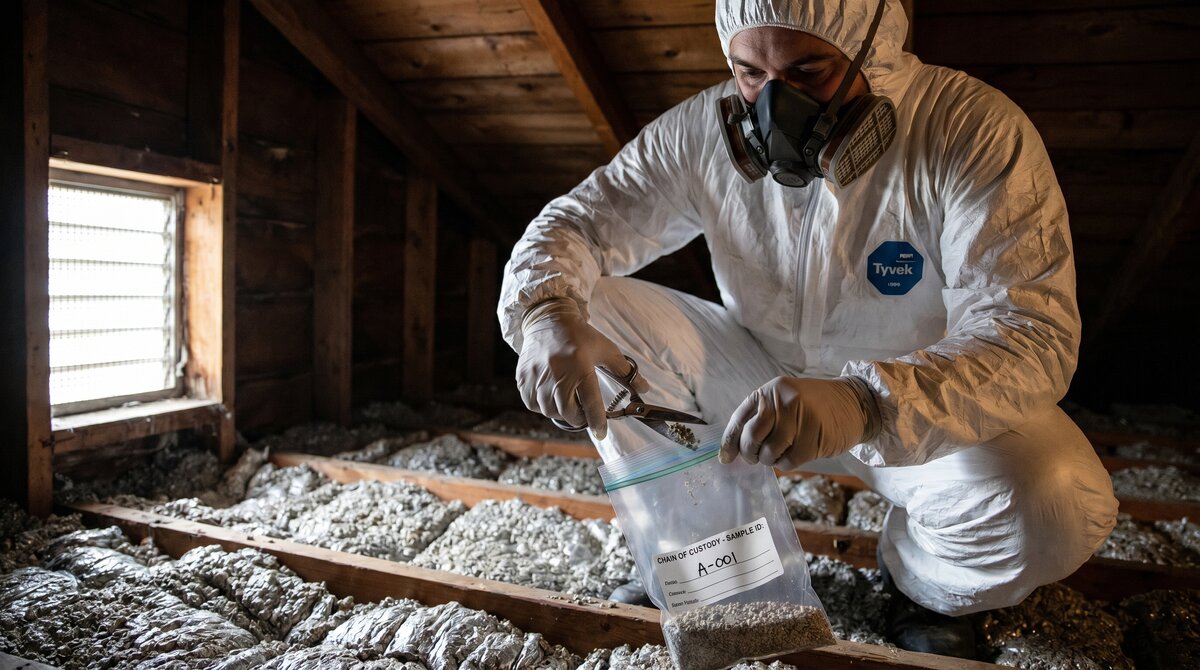
Quick answer: Vermiculite is a loose, pebble-like insulation, usually grey-brown or silvery-gold, poured between attic joists. Health Canada says it’s prudent to assume vermiculite insulation produced before 1990 may contain some asbestos. If you have it, leave it alone, keep people out of the attic, and have it tested or removed by professionals.
That advice applies to a lot of Central Alberta homes. In Red Deer, about 48% of occupied homes were built in 1990 or earlier, according to the 2021 Census. Here’s how to recognize vermiculite, how testing works and what removal involves in Alberta.
Key Takeaways
- Vermiculite insulation is loose, pebble-like and grey-brown to silvery-gold. It’s usually in attics, and sometimes inside concrete block walls.
- Much of it came from the Libby mine in Montana and was sold as Zonolite. Health Canada says to assume vermiculite produced before 1990 may contain asbestos.
- Don’t disturb it, store things in the attic or let children go up there. Seal gaps around the attic hatch, light fixtures and outlets.
- Only a lab test can confirm asbestos.
- Alberta’s Abatement Manual treats attic vermiculite removal as high-risk work. Contractors must notify OHS 72 hours ahead and use certified workers.
Table of Contents
What is vermiculite insulation?
Vermiculite is a natural mineral. The Canadian Centre for Occupational Health and Safety (CCOHS) describes it as silver-gold to grey-brown, flat and shiny in its natural state. When the ore is heated to around 1,000 °C, it puffs up and traps pockets of air, which made it useful as insulation.
The concern is where much of it came from. Vermiculite ore from the Libby mine in Montana, produced from the 1920s to 1990, may contain asbestos, according to Health Canada. That mine supplied most of the world market, mostly under the brand name Zonolite, which was sold in Canada. CCOHS notes the Libby mine closed in 1990 and other mine sites did not have the same contamination issue.
How can you tell if you have vermiculite?
Look, but don’t touch. From the attic hatch, use a flashlight to check the insulation between the joists. According to CCOHS and the US Environmental Protection Agency (EPA), vermiculite insulation is:
- A loose, pebble-like, pour-in product rather than batts or rolls
- Grey-brown or silvery-gold, sometimes described as light brown or gold
- Made of shiny, accordion-shaped pieces, from very fine particles to coarse pieces up to about 2.5 cm (1 inch) long
Alberta OHS lists both vermiculite attic insulation and vermiculite block insulation among materials that may contain asbestos, so it can also turn up inside concrete block walls. Don’t reach in, scoop a sample or crawl across the joists to get a closer look.
Spotting vermiculite doesn’t tell you whether it contains asbestos. CCOHS notes that not all vermiculite sold in Canada before 1990 contains asbestos fibres and recommends testing before doing any work. Health Canada’s position is to assume it may contain asbestos.
What does Health Canada advise?
Health Canada and CCOHS give homeowners clear, practical rules for living with vermiculite until it’s tested or removed:
| Do | Don’t |
|---|---|
| Leave the vermiculite undisturbed | Try to remove it yourself |
| Seal gaps around the attic hatch, ceiling light fixtures and outlets | Use the attic for storage |
| Keep the hatch closed and keep children out of the attic | Send anyone into the attic unless it’s necessary |
| Have a professional test it before you renovate | Start work that opens the attic or the ceiling below it before you know what’s there |
| Tell electricians, roofers and other trades that vermiculite is in the attic | Assume it’s harmless because it looks clean and settled |
There is some reassurance here. CCOHS says that as long as vermiculite stays undisturbed in the attic or behind intact walls and doesn’t become airborne, it should not be a concern. The goal is to keep it that way until you decide what to do.
How does vermiculite testing work?
A visual check can’t confirm asbestos. Under the Alberta Asbestos Abatement Manual, samples must be collected by a competent person and analyzed by a lab. Done properly, bulk sampling is a low-risk task: the material is misted first and any damaged covering is repaired right away.
Labs analyze bulk samples mainly by polarized light microscopy (PLM), which reports anything under 1% as “<1%”. Point counting improves precision for low-content materials, and transmission electron microscopy (TEM) can detect finer fibres at a higher cost. Results typically take 3 to 5 business days, with rush options at some labs.
The Manual recommends labs that take part in proficiency testing, such as the AIHA Asbestos Analysts Registry, or are accredited through CALA. If you decide not to test, follow Health Canada’s advice and treat the vermiculite as if it contains asbestos.
What does removal involve in Alberta?
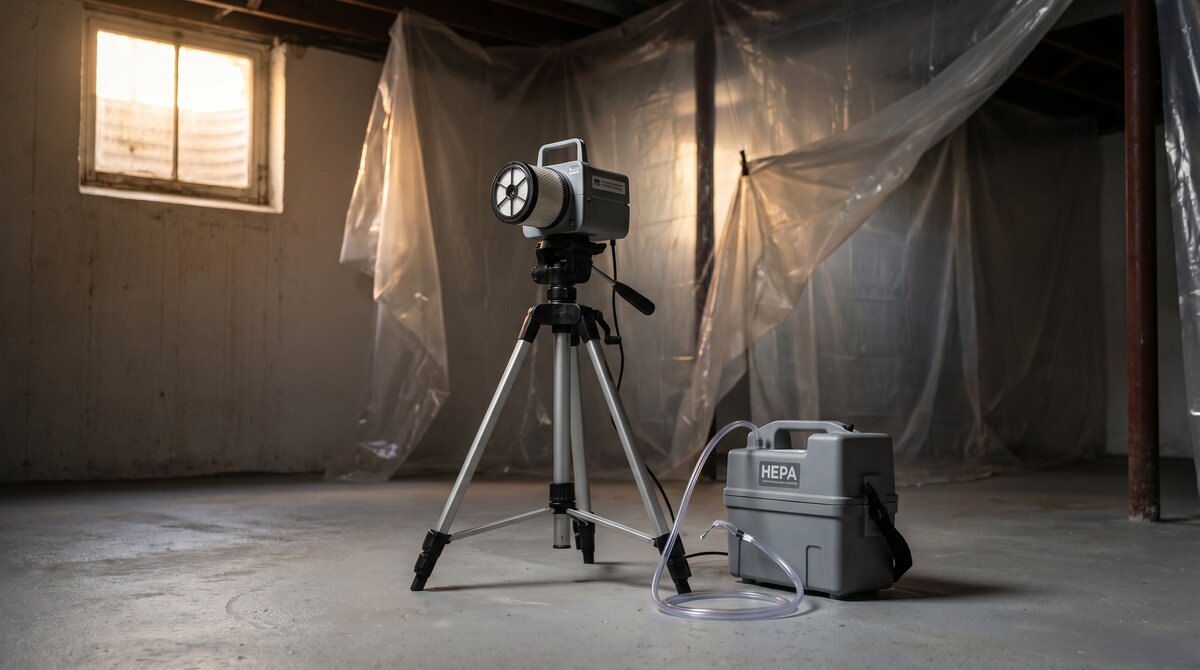
The Alberta Manual says loose-fill attic vermiculite has a high risk of fibre release if it’s disturbed. Removal follows high-risk procedures, unless a HEPA-filtered vacuum truck is used with air monitoring during the work, in which case moderate-risk procedures may apply.
Alberta’s OHS Code (Part 4, sections 28 to 40) applies to any contractor you hire. A contractor removing vermiculite must:
- Notify Alberta OHS at least 72 hours before starting work that may release asbestos fibres (s. 36)
- Use workers who hold an Alberta asbestos worker certificate, earned through an approved course of at least 14 hours and valid for 3 years (s. 37)
- Isolate the work area and keep fibre release to a minimum, following the Abatement Manual
- Seal the waste in labelled containers (s. 38) and take it only to a landfill approved to accept asbestos
In Red Deer, the City’s Waste Management Facility accepts asbestos as special waste with 24 hours’ notice. For price ranges and a step-by-step look at the job, see our asbestos removal costs, process and testing guide.
What if you’re renovating or selling?
Plan before anyone opens the attic or the ceiling below it. Adding insulation, running new wiring, installing pot lights or replacing a bathroom fan can all disturb vermiculite. Under OHS Code s. 35, a contractor must encapsulate, enclose or remove material in a renovation work area that could release fibres.
For a demolition in Red Deer, the City’s permit application asks for an Asbestos Assessment Report. If asbestos is present, an Asbestos Abatement Report must be submitted before the permit is approved. OHS Code s. 34 also requires asbestos-containing materials to be removed before a building is demolished.
If you’re selling, keep any test results and removal paperwork so buyers and their inspectors get clear answers, and ask your realtor or lawyer what you need to disclose. If you’re buying a home built before 1990, ask whether the attic insulation has been checked.
Frequently asked questions
Is vermiculite insulation dangerous if I leave it alone?
CCOHS says that as long as vermiculite stays undisturbed in the attic or behind intact walls and does not become airborne, it should not be a concern. The risk comes from disturbing it.
Does all vermiculite contain asbestos?
No. CCOHS notes that not all vermiculite sold in Canada before 1990 contains asbestos, and other mines did not have the Libby contamination issue. Only a lab test can tell, which is why Health Canada advises assuming pre-1990 vermiculite may contain asbestos.
Can I remove vermiculite myself in Alberta?
Alberta’s OHS asbestos rules apply to employers and contractors, and work an owner-occupier does on their own home generally falls outside the OHS Act. Even so, Health Canada says not to disturb vermiculite or try to remove it yourself, and the Alberta Manual treats attic removal as high-risk work.
How long do vermiculite test results take?
Labs typically report bulk asbestos samples in 3 to 5 business days. Some offer next-day or 24-hour rush service at a higher rate.
Sources
- Health Canada, Asbestos and your health (2023)
- Health Canada, Health Canada advising Canadians about potential risks to health posed by vermiculite insulation that may contain asbestos (2004)
- Canadian Centre for Occupational Health and Safety, Vermiculite Insulation Containing Asbestos (2023)
- US Environmental Protection Agency, Protect Your Family from Asbestos-Contaminated Vermiculite Insulation (2026)
- US EPA and ATSDR, Current Best Practices for Vermiculite Attic Insulation (2003)
- Government of Alberta, Alberta Asbestos Abatement Manual (ASB001) (2019)
- Alberta King’s Printer, Occupational Health and Safety Code, Alberta Regulation 191/2021 (2025)
- Alberta King’s Printer, Occupational Health and Safety Act, SA 2020, c. O-2.2 (2025)
- Government of Alberta, Asbestos exposure in demolition and renovation (ASB004) (2023)
- Government of Alberta, Course Guidelines: Occupational Health and Safety for the Asbestos Worker (CG001) (2021)
- Government of Alberta, Asbestos worker training (accessed 2026)
- Statistics Canada, Census Profile, 2021 Census: Red Deer (city) (2022)
- Western Health & Safety, Asbestos testing (accessed 2026)
- Air Quality Testing Canada, Asbestos testing cost in Canada (2026)
- City of Red Deer, Waste Management Facility (Landfill) (accessed 2026)
- City of Red Deer, Demolition Permit Application Form (2025)